Decoding Promotion Stacking Sequences: How Bettors Chain Welcome Deals Into Ongoing Arbitrage Setups Worldwide
Paul Meier · Jul 11, 2026

Decoding Promotion Stacking Sequences: How Bettors Chain Welcome Deals Into Ongoing Arbitrage Setups Worldwide
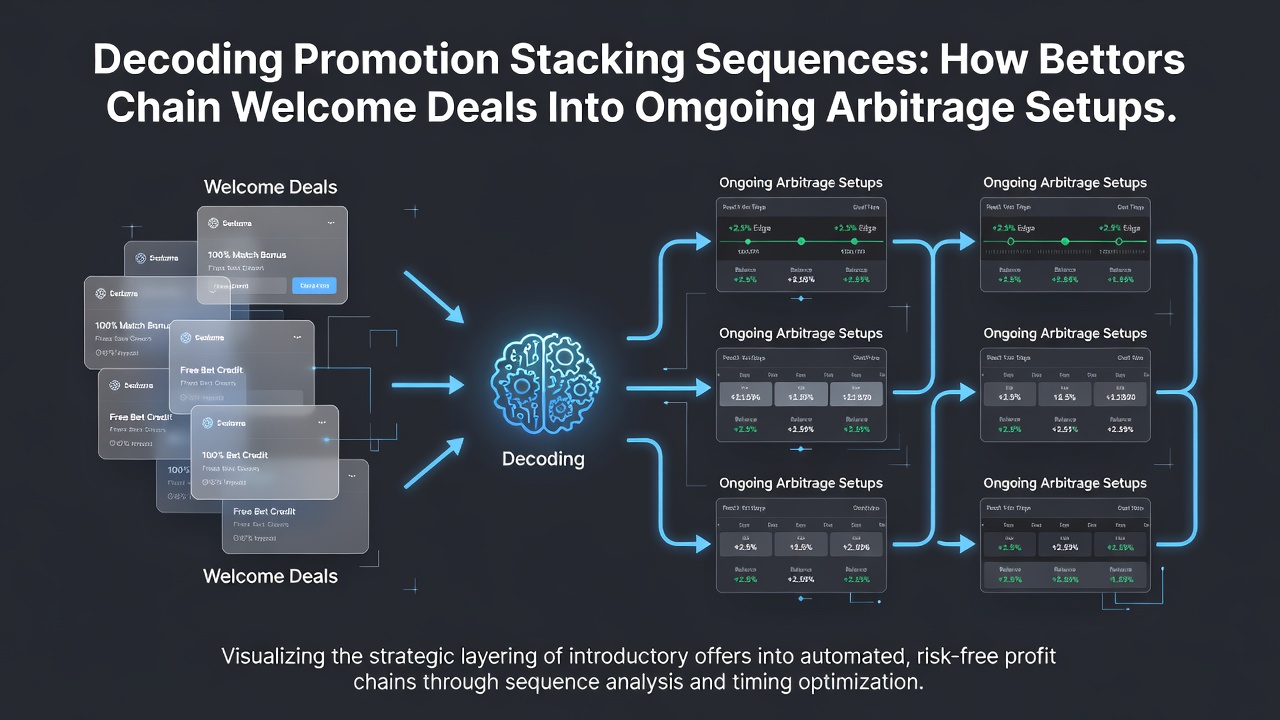
Promotion stacking sequences have emerged as structured approaches where participants link initial welcome incentives with subsequent reload mechanisms and live market discrepancies to establish repeated arbitrage opportunities across multiple jurisdictions. Data from industry tracking services indicate that such sequences often begin with sign-up bonuses on regulated platforms in Europe, North America, and Asia-Pacific regions, where operators release deposit-matched credits that convert into withdrawable balances after meeting playthrough thresholds.
Mapping the Initial Welcome Deal Phase
Operators in markets like Australia and Canada typically structure welcome packages as tiered credits that unlock over the first 30 days, allowing users to convert portions into cash equivalents through low-variance wagers on exchanges. Researchers at the University of Sydney documented how these entry points create seed capital when combined with price discrepancies between fixed-odds books and peer-to-peer platforms, noting average conversion rates above 65 percent when sequences follow predefined risk parameters.
Transitioning Welcome Credits Into Reload Chains
Once the opening bonus cycles complete, sequences shift toward recurring deposit rewards that appear on weekly calendars in jurisdictions such as New Jersey and Ontario. Bettors coordinate these reload windows with live line movements, placing opposing positions on correlated events where odds diverge by more than the combined vig thresholds. Figures released by the National Council on Problem Gambling in July 2026 showed increased activity in multi-state tracking systems, where participants maintained positive expected values across 12 to 18 sequential cycles before platforms adjusted terms.
Global Platform Interactions and Timing Windows
European operators release time-limited reload credits that align with major league schedules, whereas Asian-facing sites synchronize bonus drops with overnight Asian handicap markets. Participants monitor these staggered release times through aggregated alert systems, executing matched positions within narrow liquidity bands that preserve the original bonus value while capturing the arbitrage spread. One documented case from Canadian operators revealed sequences spanning three platforms where initial credits funded positions on tennis and basketball overlays, generating incremental balances that rolled into the next deposit cycle without additional capital injection.
Arbitrage Layer Integration and Risk Controls
Advanced sequences incorporate in-play adjustments that exploit temporary liquidity gaps during high-volume events. Exchange data streams reveal that participants maintain separate ledgers for bonus-derived funds versus personal deposits, applying strict withdrawal rules once thresholds clear. Observers note that successful chains rely on precise timing windows of 90 to 180 seconds during which correlated markets remain mispriced across borders, allowing the original welcome balance to compound through repeated matched trades.
Regulatory Frameworks Across Regions
Government agencies in multiple territories have begun publishing guidance on bonus transparency requirements, with the Australian Competition and Consumer Commission issuing updated disclosure rules in early 2026 that affect how operators present playthrough conditions. Similar measures from provincial regulators in Canada emphasize clear separation between promotional funds and user balances, reducing the scope for sequences that depend on ambiguous rollover language. These frameworks have prompted operators to publish standardized terms that participants must review before initiating new chains.
Conclusion
Promotion stacking sequences continue to evolve as operators refine bonus structures and regulators introduce clearer disclosure standards across international markets. Participants who document each step maintain records of credit conversion rates and timing windows, allowing sequences to persist within updated compliance boundaries. Data collected through mid-2026 indicates sustained activity levels where welcome incentives feed into reload mechanisms that support ongoing arbitrage positioning on global platforms.